
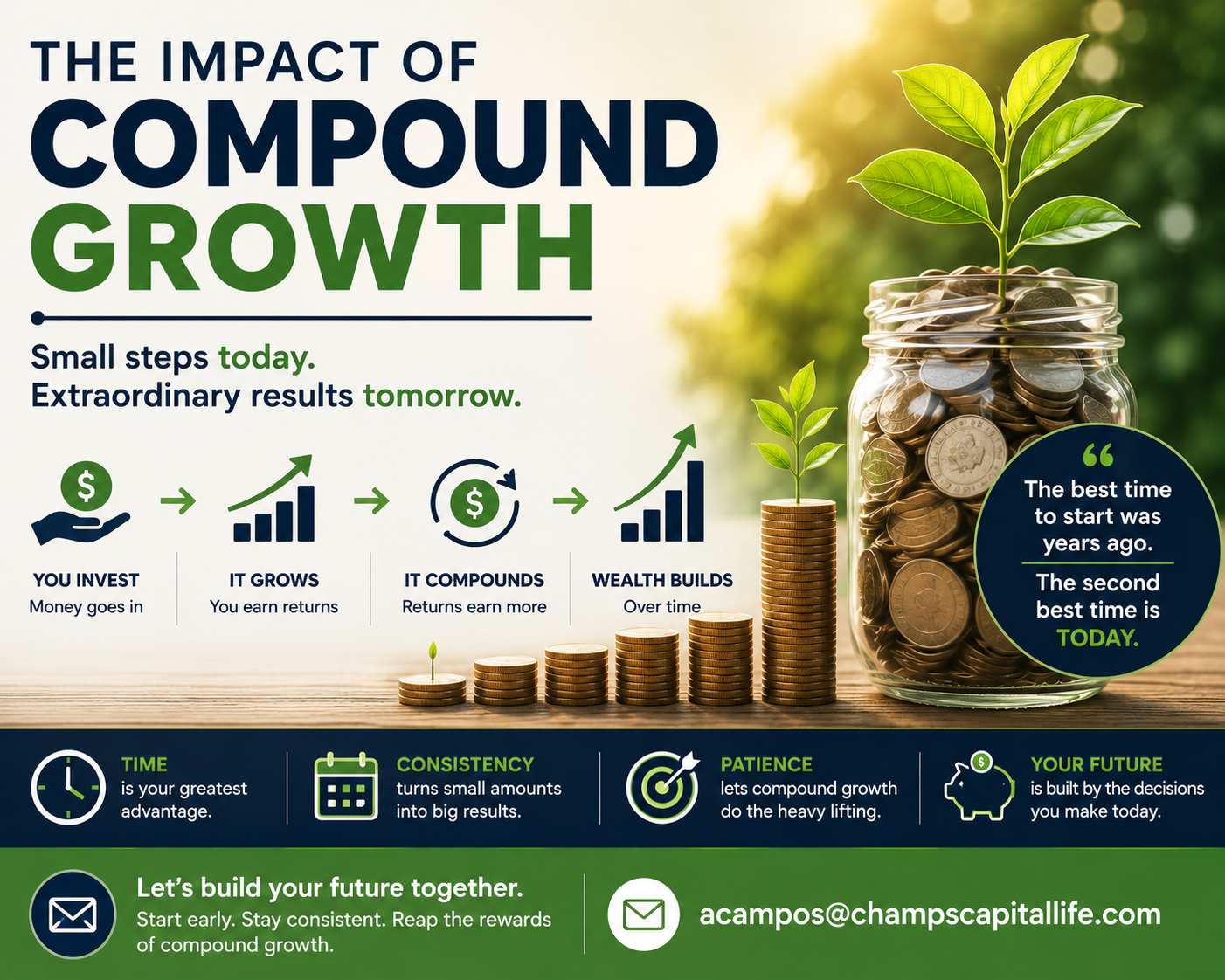
When it comes to building wealth, many people believe they need a high income, advanced investment strategies, or perfect timing in the market. While these factors can help, the most powerful wealth-building tool available to everyone is much simpler: compound growth.
Often referred to as the “eighth wonder of the world,” compound growth has the ability to transform small, consistent contributions into significant wealth over time. Understanding how it works can completely change the way you approach saving and investing.
What Is Compound Growth?
Compound growth occurs when your money earns returns, and those returns begin earning returns of their own.
In simple terms, you’re not just earning growth on your original investment—you are also earning growth on the growth that has already accumulated.
This creates a snowball effect that accelerates over time.
For example:
- Year 1: You invest $10,000 and earn 5%.
- End of Year 1: Your balance becomes $10,500.
- Year 2: You earn 5% on $10,500, not just the original $10,000.
- End of Year 2: Your balance becomes $11,025.
As years pass, the effect becomes increasingly powerful.
Why Time Matters More Than Amount
One of the biggest misconceptions about wealth building is that you need large sums of money to get started.
In reality, time is often more important than the amount invested.
Consider two individuals:
Investor A
- Starts investing at age 25
- Contributes $200 per month
- Continues for 40 years
Investor B
- Starts investing at age 40
- Contributes $400 per month
- Continues for 25 years
Despite contributing twice as much each month, Investor B may still end up with less money because Investor A gave compound growth more time to work.
The lesson is simple: starting early can be more valuable than investing larger amounts later.
The Snowball Effect
Compound growth follows a pattern that surprises many people.
During the early years, growth may appear slow and insignificant. Some investors become discouraged because they don’t see dramatic results immediately.
However, as time passes, the growth curve begins to accelerate.
The first $10,000 may take years to accumulate.
The next $10,000 may happen much faster.
Eventually, your earnings can become larger than your contributions.
This is the point where compound growth truly begins working in your favor.
The Cost of Waiting
Many people postpone saving because they feel they don’t have enough money today.
Unfortunately, waiting can be expensive.
A person who delays investing for ten years loses more than just ten years of contributions—they lose ten years of compound growth.
Those lost years can translate into tens or even hundreds of thousands of dollars by retirement.
Every year matters.
Every month matters.
Every contribution matters.
Compound Growth and Retirement Planning
Retirement planning is one of the best examples of compound growth in action.
Consistent contributions to a retirement savings plan can help create:
- Financial independence
- Additional retirement income
- Protection against inflation
- Greater peace of mind
- More options later in life
The earlier you begin, the less pressure you may feel to contribute large amounts later.
Practical Steps to Harness Compound Growth
If you want to take advantage of compound growth, consider the following strategies:
Start Today
Don’t wait for the “perfect” time. Time in the market is often more important than timing the market.
Contribute Consistently
Even modest monthly contributions can create substantial long-term results.
Reinvest Earnings
Allow interest, dividends, and returns to remain invested whenever possible.
Think Long-Term
Avoid focusing on short-term market fluctuations. Compound growth rewards patience.
Review Your Plan Regularly
As your income grows, increase your savings contributions whenever possible.
Final Thoughts
The secret to wealth building isn’t necessarily earning more money—it’s giving your money more time to grow.
Compound growth rewards discipline, patience, and consistency. Whether you’re saving for retirement, your children’s future, a home, or long-term financial security, the earlier you begin, the greater the potential impact.
The best day to start investing was years ago.
The second-best day is today.
Your future self will thank you for every contribution you make today, no matter how small.
Leave a Reply